
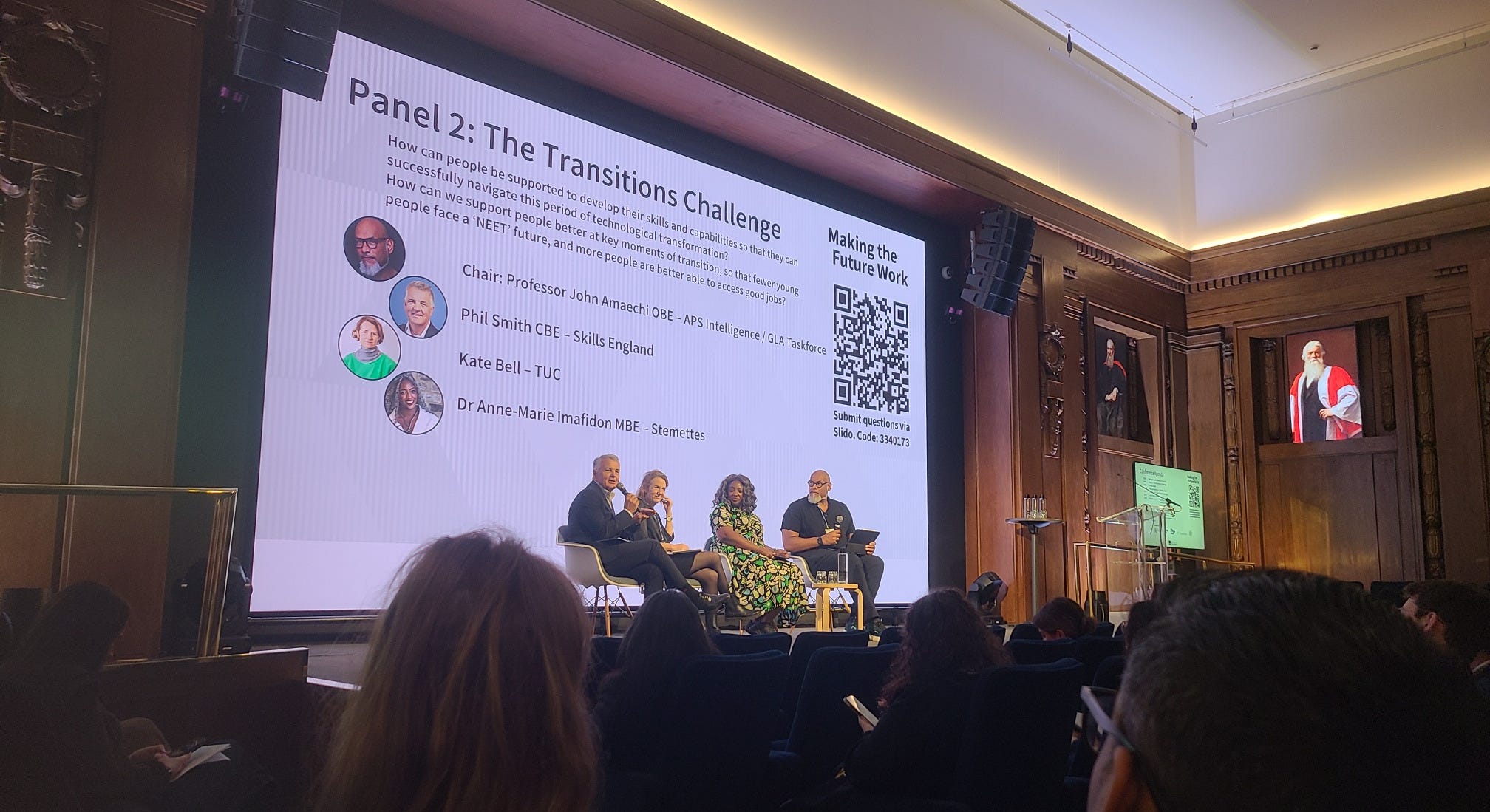
Making the Future Work – Conference Monday the 18th of May 2026, Westminster, London, UK
The Institute for the Future of Work (IFOW) is “an independent socio-technical research and development institute dedicated to transforming working lives for good”. They hosted a full day conference in Westminster, and me and my critical futures thinking hat went along. Here’s what I found, and a few things I notably didn’t.
The Future of Work is a broad topic, but this day was notably 98.5% about “AI” implementation. There’s a big government push to adopt and implement not just fast, but faster than any other G7 nation. (Cute but not possible, China and the US are both in the G7.) This means there’s a lot of people with MBEs and OBEs heading up institutes and taskforces that must make this future happen. The absence of on-the-ground delivery experience was rather palpable.
AI as if it’s about uptake
Skills gaps. Changing habits. Confidence. Being scared of a new reality – these were the topics on the main stage. A few years ago, conversations about whether people could be convinced to integrate generative AI tools into their work might have made sense. But, guys... the “barrier to AI uptake” – as jargon would put it – is that these so-called intelligent tools are often spitting out too much nonsense for people to work with it. Certainly, some engineers can definitely speed up processes – with good oversight. We can integrate algorithms to deliver better user experiences and analyse big datasets a lot more quickly. There are wins. But all those endlessly regurgitated summaries are full of error. People are turned off auto-completed emails because they’re offensively impersonal. Generated content – such as moving image – takes (a lot of) patience and expertise to produce well, on par with hiring a human motion graphics designer. And not every meeting needs to be transcribed by every participant’s “AI assistant”, to be automatically emailed to everyone else. The amount of superfluous data processing is only creating excuses to build more data centres that nobody wants. The panel handled the “AI transition” as if it’s a nationwide shift to a new CMS or HR platform. It’s not. The reality of AI in the office is that people will use a thing if it’s helpful. If it’s not, it dies lonely in a corner – and that’s how it should be.
A welcome bit of reality
As someone who’s long worked in what we call digital transformation (ongoing since 1999) – it was a relief to hear some reflect back on crude digital reality: making stuff work well is hard. Artificial Intelligence, as it turns out isn’t magic, and can’t fix all the layered tangly systemic design challenges that hamper large organisations. We wish it could, but it doesn’t. I mean, how’s your NHS app these days? Choppy at best, isn’t it. That’s not because the great teams building it don’t like using AI, trust me – they’re all very sharp digital natives. It’s because it’s complex. And, “AI” is not magic.
Linearity bias
Audibly booming in the background, there was a running assumption that “AI” will get better, become more abundant and replace many jobs.
There’s no exploration of alternative scenarios, despite numerous market tremors over hype bubbles, a huge (sometimes violent) backlash against data centres and AI, enormous cyber security concerns, the internet creaking under the pressure of deepfakes and the eradication of veracity, governments being held hostage (literally) by generative AI powered criminals, the fact that power grids can’t keep up with demand, and the real possibility that LLMs training on their own output could be the end of them. Oh, and the mounting pile of litigation against AI. (What did I miss?)
NB: Yes, I am working on these alternative scenarios. Get in touch if you’d like to collaborate.
Enlightening takeaways
Critical notes aside, there were some very knowledgeable panelists and I certainly took away great insights. Here we go.
A curveball: thought hybrid working was making us happier?
In a most engaging breakout session on Technology and Democracy, Future of Work Professor Abilgail Marks pointed out that research shows that since the pandemic lockdowns, and the rise of hybrid and remote working, work has become more intense. It’s taking up more space in our lives, the lines are blurred and this is driven by a new culture of relentless back-to-back online meetings (which demands overwork). Many people report being glad to have more time for their children, but remote and hybrid work has introduced more “always on” technology that’s led to a decrease in wellbeing.
Work v AI Ethics
Director of Responsible Business at the Thompson Reuters Institute Katie Fowler provided some incredibly revealing research outcomes from a global survey of 3000 large businesses. They used the UNESCO framework for responsible AI and Ethics to see where the world’s big corporations are when it comes to tracking or measuring potentially harmful impact of AI adoption. She cited:
18% do any impact assessments on data protection
14% on privacy
11% on environmental impact
7% on human rights
Only 12% have policies on human AI-oversight. 3% have an HR grievance process. 31% have board lever oversight of AI implementation.
Let that sink in. We’re talking about the private sector companies with the most influence in the world, with thousands of employees – such as (examples only) Unilever, Inditex, Coca Cola, HSBC. While some companies may operate through trusted third-party suppliers only and not license any other use (this often looks like being allowed to use Microsoft’s Co-Pilot only) – there is often nothing to stop employees from uploading protected information onto Grok and ChatGPT – models that train on all your data and keep nothing private.
Hard truths
The hard truths of the day came from Cambridge Law Professor Simon Deakin. Notably the only speaker who pointed out what a misnomer “AI” truly is. (If you’re not sure what I’m on about, take a look at thecon.ai.)
Hard truth no 1: what we see today with AI adoption and productivity is that it’s slowing us down, for now.
Adoption is chaotic, full of misuse, so-called hallucinations (error), untracked and the opposite of transparent. Read: LLMs are largely producing output that require a lot of human work to fix (the aforementioned intensification of work emerges again).
Note: tech adoption doesn’t equal productivity. Rather, employment rights are positively correlated with productivity.
Hard truth no. 2: Neither business and political leaders, nor the majority of the public understand “AI”.
The dominant narratives of boom/doom race are disconnected from reality. We must be more educated, so that rather than respond with fear, we can use machine learning tools in ways that truly work for and with us.
Hard truth no 3: if we don’t let the law do its work, things get violent
This is a history lesson I rather enjoyed. Deakin says the law is here to protect us, When a disruptive technology comes along, see: the early 19th century with the introduction of disrupting machinery - the law can succeed in protecting people from exploitation and destitution. If it however fails, as it did in the time of the Luddites, violence erupts. This is happening now: there is a dominant narrative that says this technology will take all jobs and there is no legal protection – we’re seeing a backlash emerging.
All secrets you to ChatGPT tell, are for Sam Altman to sell
Hard truth no 4 – most AI is borderline illegal
LLMs are trained on intellectual property that isn’t acknowledged. People’s work and likenesses are regularly stolen, privacy is absolutely not respected; all the secrets you to ChatGPT tell, are for Sam Altman to sell.
A huge amount of litigation is in progress, and this could change the reality of consumer-facing LLMs a great deal. States and bodies such as the EU are regulating at pace too.
Here Deakin again warns that where the litigation fails people, they will rise up.
Sovereign AI
It’s all the rage these days, but what does it mean – and what should it mean?
A truly stellar panel took on this topic – unafraid to say why we’re talking about it (Palantir gained access to UK government and citizen data – the company is deeply invested in autonomous weapons that have targeted and killed many civilians in Gaza, and has a CEO who is openly hostile to human rights).
Now, I had to leave the room because the plane trees gave me an incompressible cough (gah!) – but here are some snippets I caught:
Vidushi Marda: sovereignty should be about true strategic autonomy, not the illusion of control. If we fixate on needing to own the entire stack, we face a potentially unwinnable challenge. If we shift to gaining meaningful autonomy and control, we will make real strategic gains.
Matt Davies (policy researcher at the Ada Lovelace Institute) says that’s all very well, but it does happen that investments into US tech are framed as being in service of UK sovereignty. This is doublespeak. We can’t define AI sovereignty too loosely.
Jon Lloyd (Digital Public Goods Alliance) advocates for embedded open source safety features in Saas – giving users the freedom to exercise their sovereignty.
Chair Dr Abby Gilbert (IFOW) poses the question: how is our know-how, as “UK Plc” legally governed? As a digital public good? In response, Jon Lloyd says we need to shift away from the focus on individual data governance (think: GDPR) to collective industrial intelligence – a strategic necessity for a nation.
In conclusion
While it’s commendable that there’s great focus on equity, opportunities for young people and skills gaps – the conversation about The Future of Work was altogether rather narrow, and missed out on a lot of what’s happening on the ground. There was too much focus on white collar office job culture, and little on systemic causes and emerging phenomena – let alone potential shifts in the availability or desirability of automation technology.
When conversations are meant to be about the future, we must challenge assumptions and do a lot more What Iffing. For example:
What if litigation makes generative AI widely illegal?
What if the investment AI hype bubble bursts or deflates, and generative AI has to be sold at true cost?
What is the backlash against data centre expansion makes further AI rollout impossible?
What if AI data trainers and workers in the Global South get justice, and can no longer be exploited to keep LLMs running?
What if thousands of highly skilled tech workers keep getting fired, only to be re-hired at 60% pay cuts as slop fixers?
What if for geopolitical reasons, Nvidia can no longer supply chips to the US?
I have many, many more What ifs. The point being that we can’t simply assume linear trajectories. The IFOW fully adopts the narrative of an inevitable “AI Transition”, based fully on assumptions and marketing by the broligarchy. This is a dangerous path, void of critical thinking.
And then there is the true scope of The Future of Work. We have a broken social contract on our hands: the deal was that you learn, you get to earn, buy a house, afford a nice life and get to retire comfortably. That deal is off, and everyone knows it – but nobody says it out loud. Conversations about The Future of Work ought to explore either ways to restore this contract, or how to devise a new one. There was recognition in the room that what work means is changing, but it remained unspecified, opaque. Nobody talked about bullshit jobs – or the notion that many white collar jobs exist to churn, without bringing true value to anyone. What does value entail? Which jobs should we aim to automate for the common good, which should we aim to elevate with the assistance of automation, and which should we completely ringfence – safely out of reach of “AI”?
A conference on The Future of Work shouldn’t rummage in the margins of near-term tech implementation. The breakout sessions did manage to get away from this to an extent, but the overall conversation didn’t.
My brain lit up many times reading this 💡
Absolutely brilliant writeup.
On the same day the UK government is slowly waking up to the prospect of over 1m young people in UK becoming part of a lost or jobless generation and the concurrent spiralling living costs, you have raised so many important questions and provocations, particularly around the broken social contract.